
Spend three days here and you'll likely encounter more primate species than most people see in a lifetime — some by sight, at least one unforgettably by sound.
Müller's Bornean gibbon: the dawn chorus
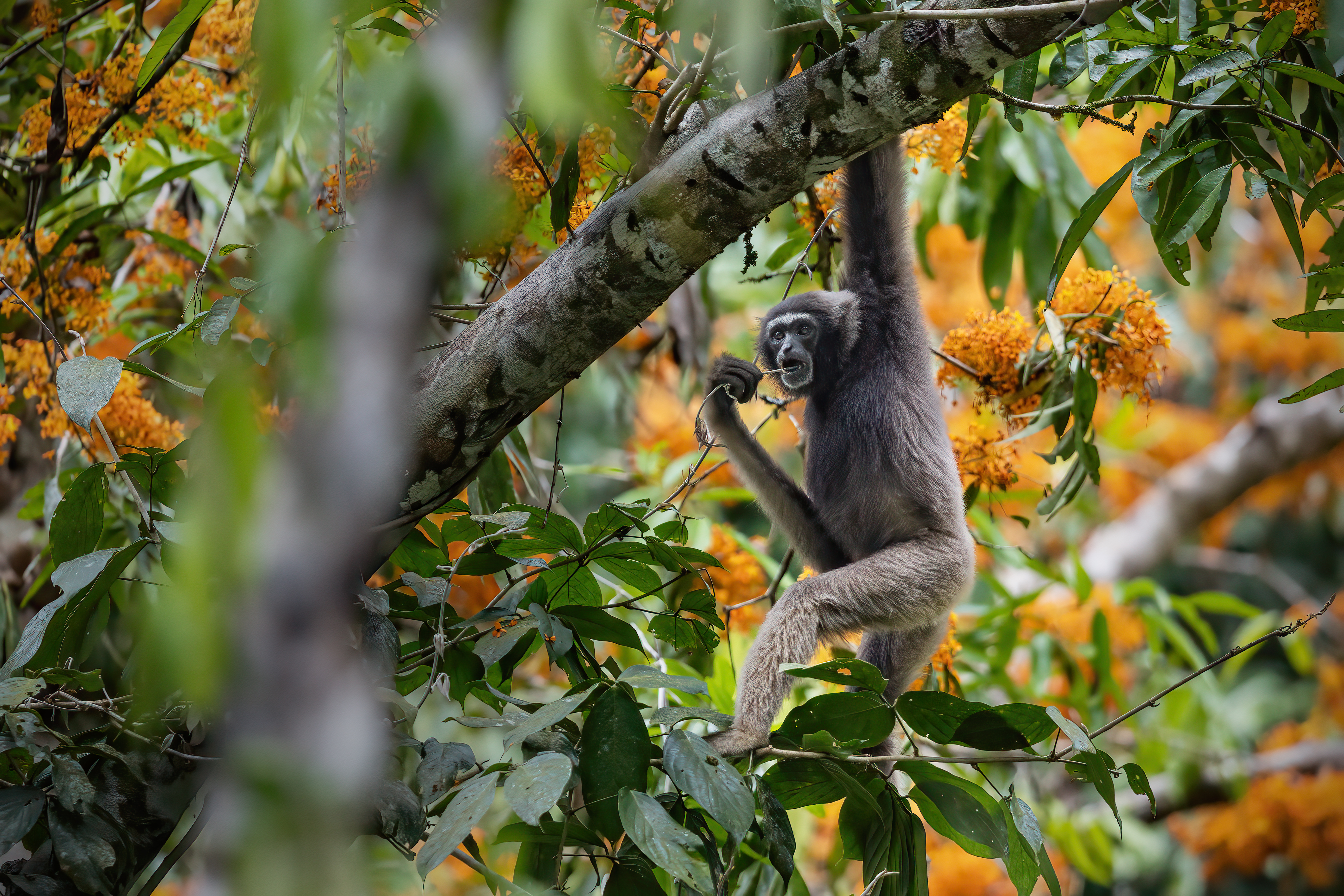
You will hear gibbons before you see them — their whooping territorial duets carry over a kilometre through the canopy and are the definitive soundtrack of a Danum Valley dawn. Seeing them takes more luck: they're fast, high, and constantly moving. When you do, their brachiation — swinging arm-over-arm through the canopy — is among the most graceful movement in nature.
Red leaf monkeys: the reliable ones
Maroon-coated and photogenic, red leaf monkeys (maroon langurs) are the primates you'll most reliably see well — they tolerate observation, travel in groups, and frequent the canopy walkway area and lodge surroundings.
The night shift: tarsiers and slow loris
Night walks reveal the strangest primates: the western tarsier — tiny, huge-eyed, capable of rotating its head nearly 180 degrees — and the slow loris, the world's only venomous primate. Both are essentially impossible to find without a guide's trained eye and light.
Also present
- Long-tailed and pig-tailed macaques — bold, occasionally cheeky around lodges
- Bornean orangutan — full guide here
Ask your guide to identify the dawn chorus layers — gibbons, hornbill wingbeats, and cicada shifts each mark different times of morning with surprising precision.