"Lowland dipterocarp rainforest" appears in every Danum Valley description. Here's what it actually means — in plain language.
The family that builds cathedrals
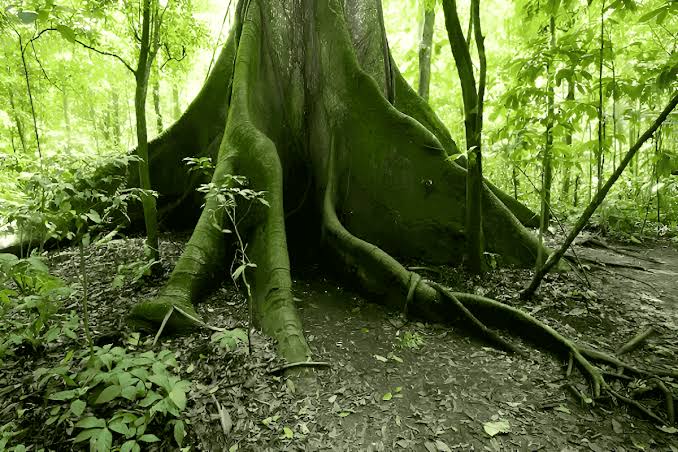
Dipterocarps — the name means "two-winged fruit," after their helicopter-like seeds — are a family of mostly Southeast Asian trees that dominate Borneo's lowland forests. They grow taller than almost any other tropical trees, forming emergent crowns that tower above the general canopy at 60, 70, even beyond 100 metres in the case of Danum Valley's Menara. Walking beneath mature dipterocarps is the closest botany gets to cathedral architecture: colossal buttressed columns, vaulted green ceilings, shafts of filtered light.
Mast fruiting: the forest's heartbeat
Dipterocarps' strangest trait: rather than fruiting annually, entire forests synchronise massive fruiting events — "masting" — at irregular multi-year intervals, often cued by climate patterns. The evolutionary logic is predator satiation: produce so much seed at once that seed-eaters can't possibly consume it all. The knock-on effects run the whole ecosystem — wildlife feasts and booms in mast years, and moves and hustles between them. It's a major reason rainforest sighting patterns vary between visits.
Why "lowland" and "primary" multiply the value
Lowland forests — below roughly 300m elevation, on richer soils — grow the biggest trees and support the highest biodiversity, which is exactly why they were logged first across Borneo. Primary (never-logged) lowland dipterocarp forest is now among Earth's rarest habitats. Danum Valley protects one of the finest surviving examples: the specific combination — lowland, dipterocarp, primary, large, connected — is what makes it irreplaceable rather than merely beautiful.
From the canopy walkway, scan for crowns rising conspicuously above the level canopy — those are the emergent dipterocarps. Guides can name the species from bark and buttress alone.